
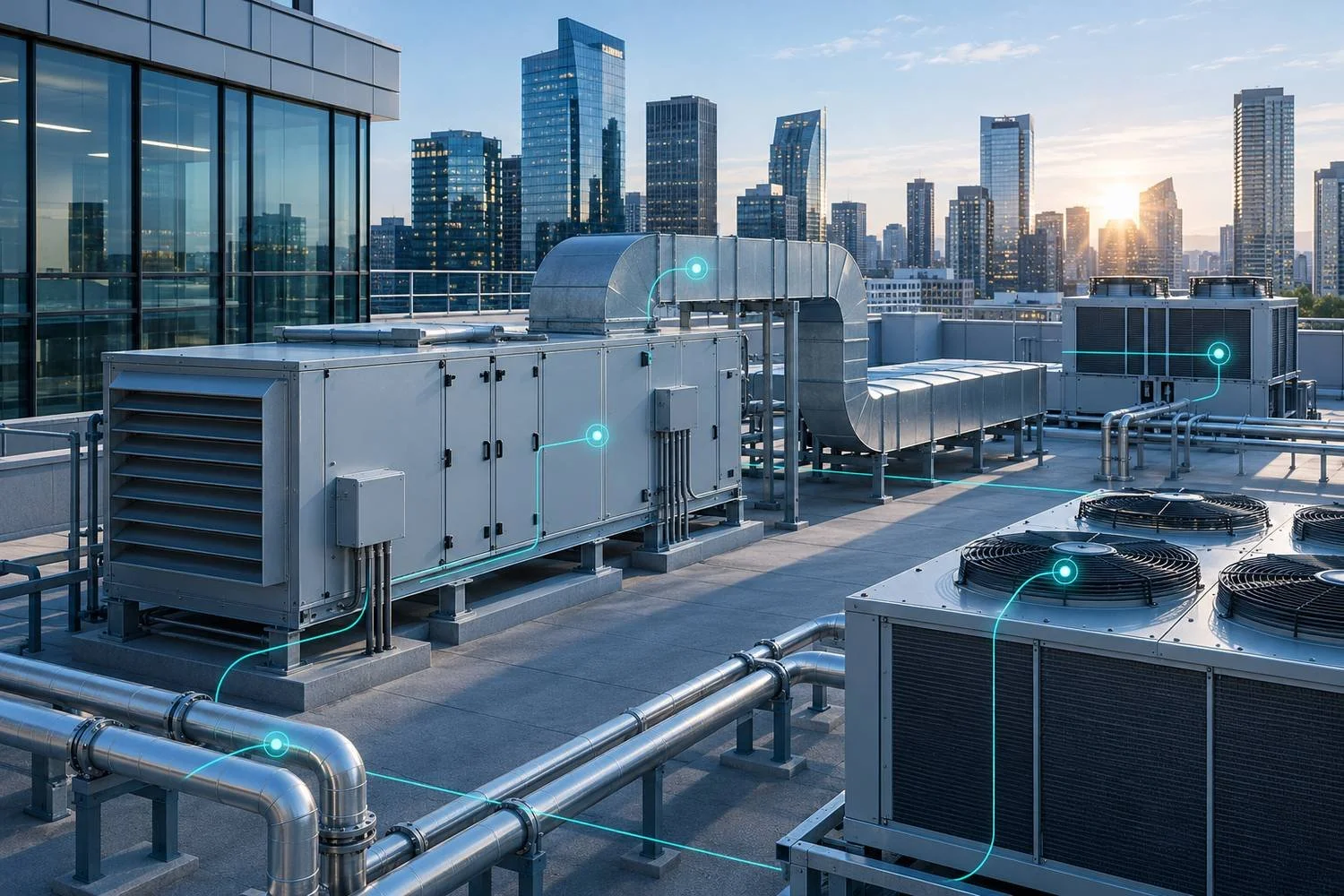
Commercial buildings produce valuable operational data every day. Temperature sensors, equipment schedules, utility meters and building automation systems all reveal how a property performs. Yet collecting information is only the beginning. The opportunity is to use that information to identify problems and guide better decisions.
AI can help detect hidden energy waste by identifying unusual patterns in building data. Combined with engineering analysis and practical HVAC expertise, these insights can help owners investigate inefficiencies that may otherwise go unnoticed.
What does AI building energy management actually do?
AI building energy management uses techniques such as machine learning to analyse operating data and identify patterns. Depending on the application, a model may estimate expected energy consumption, flag unexpected changes or help prioritise equipment investigations.
Not every building analytics tool uses AI. Many effective fault detection systems apply engineering rules: for example, checking whether equipment operates outside an approved schedule. Machine learning adds another approach by learning relationships within historical data. NIST’s research on automated fault detection explores these complementary methods.
The useful question for an owner is straightforward: does the system help the team identify a meaningful issue and decide what to do next?
Where can hidden energy waste occur?
Consider three situations that a building team might investigate.
Equipment operating after hours. An office building may be largely empty overnight while ventilation equipment continues following an outdated schedule. Comparing operating hours with occupancy requirements can reveal an opportunity to adjust controls.
Heating and cooling working against each other. Some systems legitimately provide cooling and reheating to manage comfort or humidity. However, poorly coordinated controls can also create unnecessary overlap. An alert should prompt an engineering review, rather than an automatic assumption that all simultaneous operation is wasteful.
Consumption that no longer matches expectations. A building may use more energy than expected under comparable conditions. Weather, occupancy and operating hours can all influence the result. Analytics can help highlight the change; investigation establishes the cause.
These are illustrative scenarios, not reported results from a Kontrol project.
Why reliable data comes first
A useful analysis depends on trustworthy inputs. Incorrect sensor readings, missing records or unclear equipment labels can undermine the conclusions.
Before introducing advanced analytics, owners should ask what information is available, how frequently it is recorded and whether the readings have been checked. A whole-building electricity meter can reveal an unusual overnight load, but additional equipment data may be needed to locate its source.
Turning an alert into an improvement
An alert is the beginning of a workflow. Someone must assess its importance, inspect the relevant equipment and determine whether a change is appropriate.
For example, an engineer might review a control sequence while a technician checks a valve, actuator or sensor. The team can then document the correction and monitor subsequent performance.
Verification matters. A lower utility bill alone does not establish that a particular intervention caused the improvement. Weather, occupancy and other operational changes should be considered when evaluating results.
A practical starting point for building owners
Start with one operational question: why is overnight electricity demand high, why does a zone repeatedly receive comfort complaints, or why has equipment runtime increased?
Review the available evidence, select a manageable investigation and assign responsibility for follow-through. Expand the approach once the team understands which information and workflows are useful.
For Kontrol, the opportunity connects commercial HVAC, engineering and building technology around a shared objective: better-informed building performance decisions.
Explore Kontrol Buildings’ energy management services and Efficiency Engineering’s performance monitoring to discuss where a data-informed assessment could begin.